

For millions, the first encounter with Mew wasn’t on a card but in the darkness of a movie theater or the tall grass of a video game. It was a whisper, a myth—a small, powerful creature shrouded in mystery. This mystique carried over to the Pokémon Trading Card Game, where pulling a holographic Mew felt like finding a secret. But what if that cherished card from your childhood binder is now more of a museum piece than a game piece? To learn more, check out kreolorseychelles.com
Today, the story of Mew in the TCG has split into two very different paths. On one side, you have the collectible treasures, like the iconic Ancient Mew promo card, whose value is tied to rarity and nostalgia. This is the Mew TCG card history many of us remember. On the other side, however, is a modern powerhouse. The new generation of Pokémon cards has transformed Mew from a simple collectible into a strategic Swiss Army knife, the star of one of the most popular and effective decks in the entire game.
In the fast-paced world of the modern Pokémon trading card game, Mew is not just a trophy; it’s an engine. Unlike its older counterparts that featured one or two simple attacks, today’s top Mew cards are designed for complex, high-speed strategies. These cards can copy moves from other Pokémon on the bench and are supported by a team of helper Pokémon that let players draw cards at a dizzying rate. This shift from a rare find to a competitive cornerstone is why you’re suddenly hearing its name everywhere again.
Why Are Some Old Mew Cards So Valuable?
When you see a high price tag on an old Pokémon card, it’s usually not because of what it does in a game. For collectibles, value is almost always driven by three things: rarity, nostalgia, and condition. The most valuable Mew Pokémon cards are often from limited print runs or special events from decades ago, making them scarce treasures for collectors. A mint-condition card from your childhood could be worth far more than a brand-new, powerful card simply because fewer of them exist in that pristine state. It’s a piece of history.
A perfect example is the famous “Ancient Mew” card. If you saw Pokémon: The Movie 2000, you likely received one of these. As you can see in the image, it looks more like a mysterious artifact than a typical playing card, covered in strange, runic text. The Ancient Mew card value comes from this unique design and its connection to a major cultural moment for fans, not from any in-game power—in fact, it was banned from official tournaments for being too difficult to read!
This distinction between collecting and playing applies to many fan-favorites, where a high Shining Mew card price is due to its special holographic art and rarity, not its attack stats. The key takeaway for any card is to ask: is this valuable for a binder, or for a battle deck? While these older cards are treasured collectibles, the powerful Mew cards used in today’s game look very different, often with letters like “V” or “VMAX” in their name.
What Do “V” and “VMAX” Mean on Modern Pokémon Cards?
If you’ve glanced at any modern Pokémon cards, you’ve likely seen huge HP numbers and the letter “V” or “VMAX” next to the Pokémon’s name. These aren’t just for show; they represent a fundamental high-risk, high-reward style of play built around Prize Cards. In a Pokémon TCG match, each player sets aside six cards from their deck face-down. These are their Prize Cards. Every time you knock out an opponent’s Pokémon, you take one of your Prize Cards into your hand. The first player to take all six wins.
A Pokémon V is a super-strong version of a regular Pokémon with much higher HP and more powerful attacks—think of it as a boss-level character. However, this power comes with a risk: if your Pokémon V is knocked out, your opponent gets to take two Prize Cards instead of one.
Taking this a step further is the massive Pokémon VMAX. These are giant, evolved forms that you play on top of their corresponding Pokémon V (for example, you play a Mew VMAX card on top of a Mew V card). A VMAX Pokémon is an absolute powerhouse, often boasting over 300 HP—more than double a typical card from the game’s early days. Their attacks can be game-winning on their own. The trade-off? If your opponent manages to knock out your Pokémon VMAX, they take a massive three Prize Cards. That’s half the total they need to win the entire game, all from a single knockout.
The core difference, then, is a ladder of power and risk. You are betting that the incredible strength of your V and VMAX Pokémon will let you win the game before your opponent can capitalize on the huge prize payout.
- Pokémon V: A strong, basic Pokémon. When knocked out, your opponent takes 2 Prize Cards.
- Pokémon VMAX: An even stronger Pokémon that evolves from a V. When knocked out, your opponent takes 3 Prize Cards.
This gamble is exactly what makes the modern Mew deck so thrilling. But it isn’t just Mew’s high HP that makes it a top-tier choice; it’s the clever way its main attack works.
The Swiss Army Knife: How Mew VMAX’s Main Attack Works
The secret to Mew VMAX’s dominance isn’t just its high HP; it’s the cleverness of its main attack, “Cross Fusion Strike.” For a cost of two Energy cards of any type, this attack allows Mew to choose one attack from any of your “Fusion Strike” Pokémon on your Bench and use it as its own. This works because of a core concept in the Pokémon TCG: the Bench.
In a match, your main, “Active” Pokémon does the fighting. Behind it, you can have up to five other Pokémon waiting in reserve on the Bench. Think of it like a dugout in baseball or the sidelines in basketball; these Pokémon are part of your team, waiting for their turn to enter the game. While they can’t attack directly from the Bench, their presence is crucial for strategy.
Mew VMAX’s true power comes from this setup. While it’s in the Active Spot, it can peek over its shoulder at its Benched teammates and essentially borrow one of their attacks for the turn. Imagine having a toolbox of different attacks available at all times. If you need a quick, cheap hit, you can copy one. If you need a massive, powerful blow to knock out another VMAX, you can copy that instead. This turns Mew VMAX from a simple beatstick into a versatile Swiss Army knife, capable of adapting to almost any situation.
This copying ability is what makes a Mew VMAX deck so incredibly flexible and unpredictable for an opponent. You’ll notice that Mew and its preferred teammates all have a pink “Fusion Strike” stamp on them. This label simply identifies them as part of a specific team, allowing their abilities and attacks to work together seamlessly. To make this strategy work, however, Mew needs the right teammates on the Bench to provide a menu of powerful attacks. And none are more important than its primary partner, the real engine of the deck: Genesect V.
The Engine Room: Why Genesect V is Mew’s Best Friend
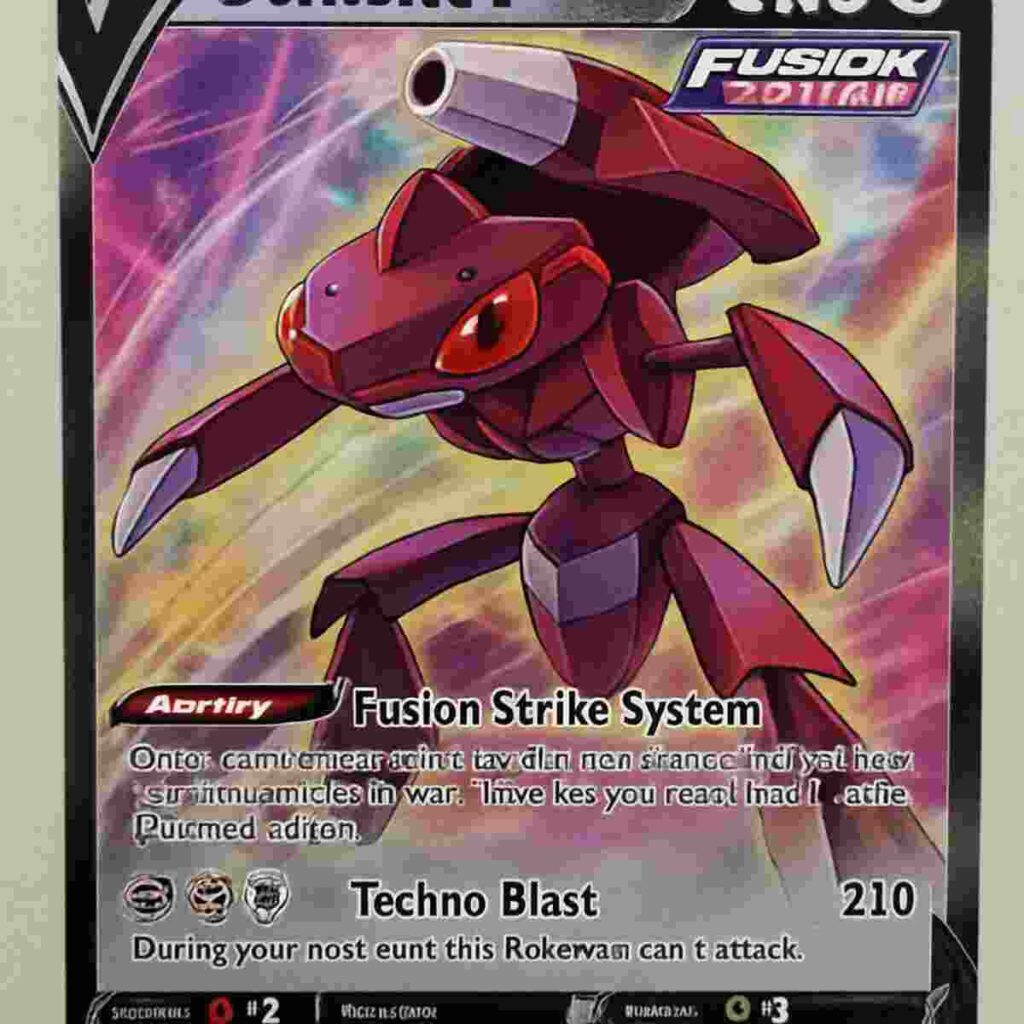
While Mew VMAX is the star of the show, every star needs a brilliant support team. For Mew, that indispensable teammate is almost always a Pokémon called Genesect V. Though it shares the same “Fusion Strike” team label as Mew, Genesect V rarely does any of the fighting. Instead, its value comes from a special skill printed on the card called an Ability. Unlike an attack, an Ability is a power a Pokémon can use without needing Energy, often from the safety of the Bench. It’s a bonus action that can completely change the flow of a game.
Genesect V’s incredible power comes from its “Fusion Strike System” Ability. This allows a player to draw cards from their deck until the number of cards in their hand is equal to the number of their “Fusion Strike” Pokémon in play. In the Pokémon TCG, having more cards in your hand is one of the most powerful advantages you can have. Think of your deck as a toolbox; drawing more cards is like quickly pulling out every tool you might need instead of fumbling around for the right one. This action, known as card draw, is what makes a deck consistent and reliable.
With several Genesect V on the Bench, a player can use this Ability multiple times in a single turn, sometimes drawing a dozen or more cards. This creates a powerful “engine” that rapidly searches through the deck to find key pieces like Mew VMAX itself, the Energy cards needed to attack, and other useful items. This partnership—Mew VMAX as the versatile attacker and Genesect V as the reliable engine—is what makes the deck both so fast and so difficult to stop. It ensures that Mew always has what it needs to adapt and strike.
Getting Started: How to Build a Basic Mew VMAX Deck
Jumping into the game can feel overwhelming, especially when you see players with perfectly crafted decks. Thankfully, The Pokémon Company provides an amazing shortcut for players wanting to pilot this deck: the Mew VMAX League Battle Deck. This product is a complete, 60-card deck that’s ready to play right out of the box. It contains Mew VMAX, Genesect V, and all the essential supporting cards you need for the core strategy to function, making it the ideal entry point.
While this pre-built deck is strong on its own, one of the most exciting parts of the TCG is customizing your strategy to make it even better. For the Mew VMAX deck, the single most effective upgrade you can make involves adding more copies of a powerful card called Power Tablet. The League Battle Deck comes with some, but adding a few more can significantly increase your damage output.
Power Tablet is an Item card. Unlike Pokémon or Energy, Item cards are single-use tools that you play from your hand for an immediate effect, then discard. Think of them as tactical items in a video game, like a potion or a temporary power-up. In this case, each Power Tablet gives all of your “Fusion Strike” Pokémon a 30-damage boost for the turn. Playing two or three at once can transform a regular attack into a massive, game-ending knockout blow.
Your path to playing one of the game’s best decks is a simple two-step process:
- Purchase the Mew VMAX League Battle Deck.
- Acquire two or three extra Power Tablet cards to add to it, which you can find by trading or buying them as “singles” from a local or online card shop.
With this powerful and accessible foundation, you’ll be ready to see just how this deck stacks up against the competition.
Is Mew VMAX Still a Top Contender?
With a powerful deck in your hands, you might wonder: is Mew VMAX still good enough to compete? The short answer is a resounding yes. In the Pokémon TCG, there’s always a collection of popular and powerful decks that you’ll see most often—a concept players call the “meta.” This landscape of top strategies is constantly shifting as new cards are released, but Mew VMAX’s incredible speed and consistency have kept it a dominant force for years. It’s not just good; it’s often the benchmark for how fast a new deck needs to be in order to succeed.
One of its classic rivalries, the matchup against Lugia VSTAR, highlights how Mew fits into this competitive puzzle. While the Mew VMAX deck is all about lightning-fast aggression and drawing lots of cards, the Lugia VSTAR deck plays a different game. It’s a bit slower to get going, but it focuses on building up enormous, powerful attackers that can knock out even a mighty Mew VMAX in a single hit. This creates a thrilling “speed versus power” dynamic. The Mew player must race to take all their prize cards before the Lugia player can unleash their unstoppable force.
This core tension is what keeps Mew VMAX so relevant in the Pokémon TCG meta. Its straightforward, high-speed game plan puts immediate pressure on opponents, forcing them to have an answer or risk being overwhelmed. While some decks might have a raw power advantage, few can match the turn-after-turn reliability that Mew VMAX brings to the table, making it a fantastic and enduring choice for both new players and seasoned veterans.
How to Beat the Mew VMAX Deck: Two Simple Strategies
If Mew VMAX is so fast and consistent, how does anyone ever beat it? While its speed is intimidating, this powerful deck has two well-known Achilles’ heels. Exploiting these weaknesses is the key to turning the tables. Rather than trying to out-race Mew, the best strategies involve either hitting its critical weak spot or shutting down its engine entirely.
First and foremost, every Pokémon in the card game has a “Weakness” to another type, which you can find listed on the card. Think of it like a critical hit in a video game—if a Pokémon is attacked by a type it’s weak against, it takes double the damage. For all its power, Mew VMAX has a Weakness to Darkness-type Pokémon. This means even a moderately strong attack from a Darkness Pokémon can be enough for a one-hit knockout, completely bypassing Mew’s high HP and earning a quick three Prize cards.
The other major strategy is a bit more clever: you can sabotage the deck’s card-drawing engine. Since the whole deck relies on Genesect V’s Ability to draw cards, players can use cards that “lock” or turn off all Abilities. One of the most popular ways to do this is with a “Stadium” card called Path to the Peak. A Stadium is like a temporary battlefield rule that affects both players, and this one specifically states that powerful Pokémon V (like Genesect V) can’t use their Abilities. When Path to the Peak hits the field, the Mew deck’s engine grinds to a halt, buying you the time needed to mount a comeback.
Your Guide to Mew: From Nostalgic Icon to TCG Master
From a mysterious legend in a movie theater to a modern champion of the Pokémon TCG, Mew has completed a remarkable journey—and so have you. Where you once saw just a beloved character, you can now see the dual identity of a treasured collectible and a powerhouse of competitive play. You’re no longer on the outside looking in; you now possess the core insight into what makes one of the game’s top decks tick.
You’ve seen that the strength of the mighty Mew VMAX doesn’t come from its power alone. Its success is fueled by its partner, Genesect V, a relentless “card-drawing machine” that ensures the deck runs with blistering speed. This relationship between the star attacker and its support system isn’t just a fun fact; it’s the fundamental secret to understanding Pokémon TCG strategy.
This knowledge is your new lens for the entire game. The next time you watch a match or see a friend’s new deck, look past the big, flashy attacker. Ask yourself one simple question: “What’s its engine?” Spotting that hidden support system is the first step from being a fan of Pokémon to truly understanding how the game is played.